

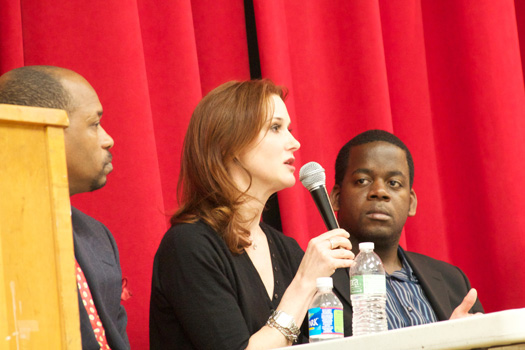
Author Jacqueline Edelberg speaks at the Henry C. Lea School on Thursday as Tune Up Philly director Stanford Thompson (right) and Lea Home and School Association president Maurice Jones look on.
The angst over budget cuts and half-day kindergarten were temporarily set aside at Henry C. Lea School (4700 Locust) yesterday so community members, teachers and parents could talk about how to make their school great.
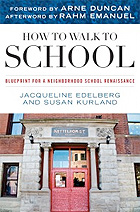
About 125 people gathered in Lea’s auditorium to hear a panel that included Jacqueline Edelberg, a parent who helped lead the transformation of Nettelhorst, her neighborhood school in Chicago. She and co-author Susan Kurland, Nettelhorst’s former principal, chronicled the change in the book How to Walk to School: Blueprint for a Neighborhood School Renaissance.
Eight years ago, as Edelberg began looking for school options for her pre-school age children, she was advised not to send them to Nettelhorst, a 300 students which was then populated almost exclusively by children bussed in from outside the neighborhood. She didn’t know anyone from the neighborhood who sent their children to the school, where the test scores were abysmal and the building itself was gloomy.
“I liked my neighborhood,” she said. “The idea that I would have to leave my neighborhood because my kid turned five struck me as kind of weird.”
The transformation began, she said, when Kurland approached her and other parents and asked what it would take to get them to send their kids to Nettelhorst. The parents made up a list that included things that any parent would want for their children: a great curriculum that included foreign languages, music, art, sports, a beautiful building and community involvement.
Very few wanted to be among the first families from the neighborhood to send their child to Nettelhorst. Edelberg took the chance.
She and a small group of parents formed committees for things like curriculum, marketing and fundraising. But the most important step, she said, was to open the school up to the community. The school to agree to allow at least one parent in every classroom every day.
“That really helped mollify a really skittish situation so (parents) knew that someone was minding the store,” she said.
That parental involvement also drove teachers that the parents considered ineffective to leave.
“I think the PC way to put it,” Edelberg said. “Is that teachers who did not share our educational vision found suitable accommodations elsewhere. And that happened very, very quickly.”
Now almost a third of the adults in Nettelhorst every day are parents. They also invited community members, artists and others, to the school. They started a farmer’s market on school grounds, which brought in more community members.
These and a long list of other changes turned the school around. “I would put my kid’s education on par with any private school in this country,” she said. “I believe it is that good.”
Nettelhorst has achieved this, she added, without tracking students, without selective enrollment and with no gifted program.
Maurice Jones, a Lea parent and president of the school’s Home and School Association, has looked to the Nettelhorst model in his own efforts to help transform Lea, the neighborhood school for many families who live just outside the catchment for the vaunted Penn Alexander School (43rd and Locust).
“I could send my children to any school, public or private, but I choose to send them to Lea,” he said.
Jones has helped forge ties with the community that has led to the creation of a Visual Arts Program at the school, a community garden and a singing group, the gLea Club. But he wants more change.
Panelist Stanford Thompson offered last night to help him out. An accomplished musician, Thompson is director of the Philadelphia Youth Orchestra program Tune Up Philly, which brings performance-based music programs into city schools. A West Philly resident, Thomspon is currently working on a program at the St. Francis de Sales School (47th and Springfield) which has drawn praise from all corners of the city. Last night, he offered to bring the program to Lea, which drew applause from the audience.
“I look at this room and I see a roomful of folks who could figure out how to fix schools in West Philly,” said Thompson.
Edelberg stressed that change would not be easy. At Nettelhorst change meant grappling with charges that the improvements were simply byproducts of gentrification that benefited some students at the cost of others.
“They aren’t. It is across all class lines in all kinds of neighborhoods where you can have successful schools. I kid you not, the only thing that matters is engagement,” she said.
Policymakers told Edelberg and others that their model would not scale – the changes at Nettelhorst might not work in other neighborhoods
“The idea that moms or dads or normal people cannot affect change is so maddening to me,” she said. “Schools aren’t anything more than a collection of adults trying to do right by kids. That’s it.”
Edelberg also stressed that now is the time for parents to act. Documentaries on school reform like Waiting for Superman and others have widened the discussion on community and parent engagement as a way to improve schools.
“We have a very short window of opportunity here,” she said. “Right now more people are talking about school reform than have in decades.”
Jones and others hope to steer that momentum toward Lea, a K-8 school built in 1914. He told the audience that he expected some resistance.”I’m trying to change the tide here,” he said. “So we’re asking people to get in the boat to help us.”
The changing demographics of the neighborhood around Lea will also likely be a factor in changing the school. Home prices in the area, particularly between Market Street and Woodland Avenue have risen sharply in recent years. Most of the audience at last night’s discussion were white, while the school’s 395 students are 87 percent African American, according to School District of Philadelphia statistics.
Many families that live near the school choose to send their children to the Samuel Powel School (301 N. 36th St.) Most have to drive their children to the school. One woman who attended the meeting and asked that her name not be used said she drove her children to Powel every morning. She lives at 48th and Osage and was interested in the panel discussion because her children could walk to Lea if she chose to send them to school there. When asked if she would, she said that she would wait to see what happened at Lea.
“I’m not ready yet,” she said. “Not yet.”






Recent Comments